
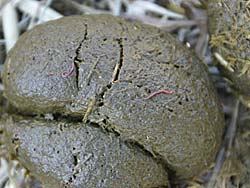
Prior to starting any deworming program, a fecal egg count (FEC) should be done. This will help to determine your horse’s parasite load, the efficacy of your current parasite control program, and identify any high shedders in your herd.
There has been some parasite resistance reported with all dewormers, so we recommend that an FEC be done two weeks after deworming positive horses. This will check to see if your horse has worms that are resistant to the dewormer you are using.
Just bring us a few fresh fecal balls; we’ll take care of the rest!
Dewormers
There are a variety of deworming products on the market today. Most will do an excellent job of protecting your ADULT horse against internal parasites when used appropriately. To avoid developing worms that are resistant to the available dewormers, deworming should be part of a targeted deworming program, rather than simply “rotating” products every 8-12 weeks. It is also important that your horse be dosed for the correct weight.
Good Practices
To minimize your horse’s exposure to parasites, all horses that share a pasture should be dewormed at the same time. Exception: “High shedders” will need to be dewormed more often their “low shedder” pasture mates. When adding a new horse to the pasture, it should be dewormed several days before it is turned out onto the field. Horses under 1 year of age, or thin and debilitated horses require special deworming programs; contact us for a specific program for these horses.
Deworming Products
Ivermectin: The first paste dewormer to kill bots at any stage in the horse. Is also responsible for the vast decrease in verminous arteritis colics by killing the large strongyle larvae that can live in the mesenteric artery (the main artery supplying blood to the intestines). Deworming interval with ivermectin is 8 weeks. Not recommended for horses under 4 months of age. (Eqvalan, Zimectrin, Equell)
Moxidectin: The newest dewormer on the market, kills bots at any stage. It kills small strongyle larvae encysted in the intestinal wall. These larvae are responsible for many of the late winter/early spring colics when they emerge from the intestinal wall. Deworming interval is 12 weeks. Not for use in horses under 6 months of age. (Quest )
Pyrantal Pamoate: Does NOT kill bots. At a double dose, does a good job of killing tapeworms. Deworming interval is 6-8weeks. (Strongid P)
Praziquantel: Excellent at killing tapeworms. Does not kill strongyles or roundworms. Only comes combined with either Ivermectin or Moxidectin.
Fenbendazole: One of the original dewormers. There is significant resistance of some worms to this drug, so check with us for its appropriate usage. It is most often used as part of a 5 day, double dose larvicidal treatment. (Panacur, SafeGuard)
Oxibendazole: Related to Fenbendazole, but little worm resistance. Deworming interval is 6-8 weeks (Anthelcide EQ)
Pyrantal Tartrate: Used as a daily dewormer. Very useful in situations where not all horses on the premises are on a good deworming program. Controls “incoming” parasites, Horses must be dewormed with either Ivermectin or Moxidectin prior to starting daily deworming program, and then every 6 months thereafter. Not recommended for horses under 1 year of age due to rapid gastric emptying time.
Deworming Programs
Regardless of which program chosen, it is important to have a fecal exam done just prior to starting a deworming program in the spring.
The results of the test, along with your horse’s deworming history, can help us choose the most effective program for your individual horse. We would be glad to personalize a deworming program for your individual horse or horses.
 evergreenequinevt.com